Sunday, May 17, 2009

French Breakfast Radish Harvest

The French Breakfast radish harvest has proven to be a lovely early crop. Cyrus apparently loves radishes (at least this year he does).

(an email)

"Your son is a fellow radish lover. The kids each picked one this morning, which I was annoyed with until they washed and ate them! I was surprised, so I said: If you like them, you may pick them whenever you want. One at a time. And that's what Cyrus did for like 10 radishes. I guess they call them french breakfast radishes for a reason. =)"
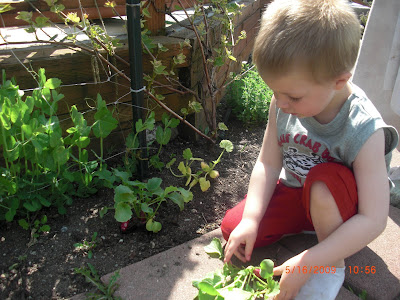


Cyrus harvesting the last of the French Breakfast radishes....


Satya hasn't proven to be a radish lover like Cyrus and I, but this is a fun photo all the same. :)

Final harvest for the French Breakfast radishes were about two weeks over due. Not really too bad considering the winter/spring we've had. I'll definitely look towards radishes as being an early garden gem in the future.


Sunday, May 3, 2009

Sunflowers

We transplanted the sunflower starts today! The primary focus of the garden is food, but...

"We want to plant flowers for the bees because they help the vegetables grow"

"Why do they help the vegetables grow?"

"They land on all the flowers and take care of the flowers, and the flowers turn into vegetables."

"Oh!" (Happy smile)

Once before I tried using the word 'pollination' in an explanation, but that didn't really sink in. The fact that bees sting, but they are still considered "Good Guys" was a source of confusion. The bees-take-care-of-flowers logic seemed to get traction. I figure it's a good enough explanation. It forms the linkage between bees, flowers, and us; which is really the important part of the concept. A 5 year old doesn't care about the technical 'how' of pollination. It's too abstract. 5 year olds are only concerned with 'why'.

We definitely need more flowers in and around the garden....

I found a list of edible flowers that looks very promising. One flower in particular looks very promising: nasturtium. They come in all manner of colors, there are climbing varieties, and best of all... the flowers go great in salads and can even be pickled! Other fun facts about them are that humming birds like them and they tend to attract aphids away from the veggies. Looking for seeds, I found yet another online seed company that is really great- Renee's Garden. (Her selection of nasturtium seeds in particular has no peer.) I'm starting to think that all the vertical space we have can be fully incorporated into the garden.

Wednesday, April 29, 2009

Radish Harvest!.... (Not quite)

Yesterday was the 30 day mark for our French Breakfast radishes. (Top front row, right hand side.) They're a little behind schedule... but not by much. 23 days after planting we were thinning the crop and enjoying the sprouts in dinner salads; so we've discovered that planting radishes has a two-fold harvest! :) I'm not too bothered by the delay in maturation, this is the beginning of spring after all... planting this variety again in mid-summer will be interesting study.

The peas directly behind this crop of radishes are the faster 55 day Sugar Sugar snap peas. We'll have to put up the lattice for those reasonably soon. I think that we may be able to get one more planting in front of these snap peas - but it will have to be something with a fast maturation. Once the snap peas get bigger, the space in front of them will be overwhelmed and will have to be left alone for the rest of the season.

A second crop of radishes, "White Icicle Heirloom" was just planted in front of the 90 day Sugar Star snap peas. These are super fast- just 23 days. (!!) I'm trying to get better about off-setting the plantings so we have continual harvests, so I only used half the pack. At the same time, this is the first planting where I was really trying to be mindful of seed dispersion and spacing so as not to waste seeds. (This was a bit tricky for assistant Cyrus, who was not particularly mindful as to how the seeds landed...)

I've been researching succession planting- which is different techniques for maximizing the space you use. Thanks to the calendar, I'm able to quickly see what has been planted when- so that makes planting in timed intervals much easier. Another succession planting technique is re-seeding a space immediately after harvesting a crop. (A cold season/warm season planting) This will take more research to make sure the vegetables that get planted are complementary in terms of soil management. There's also inter-cropping, which involves two or more plantings in the same space at the same time that complement each other. The Three Sister's technique, developed by the Iroquois is an example of this. I'd really like to try this if I can get the new terraced garden done by the beginning of June.

Monday, April 27, 2009

Strawberry Bed Preperation

Finally finished getting the strawberry bed cleaned up and fertilized. Untangling runners is distinctly not a fun task. =P
Last year the strawberries were one of the big success stories of the garden. For a couple of weeks during the beginning of July we could take our a salad size bowl and fill it nearly to the top *every day*. We'd like to see that again this year.
We're not sure exactly what variety we have- but they are an early season variety with nice big fruit. We did have some ever-bearing plants mixed in, but the early season varietal is much more aggressive and has pretty much taken over the entire bed. I've got a project in mind in the future where I'll create an additional strawberry bed... when that happens, I'll go for mid/late season plants so we can have a longer harvest season.
I found a great write-up called STRAWBERRIES IN THE HOME GARDEN published by NC State. Included in it is a month-by-month guide to strawberry care that is really fantastic. I'll probably reference this in the future.... in hindsight we should have thinned the plants back in September and fertilized well before now. Oh well. Pretty much between now and September we just need to make sure this plot stays well watered.

Wednesday, April 22, 2009

Over-wintered cabbage


We had several cabbages that were planted in fall by the Seattle Urban Farm Company (Great guys...)

The cabbages survived a particularly harsh Seattle winter, and come spring started looking great... but then the vast majority of them bolted. :( Researching why this happened, we found that it was either due to a sudden change towards warmer temperature... or an over-abundance of nitrogen at the wrong time. We had both. =P

We fertilized the cabbages at the beginning of April *and* we got a pretty good uptick in temperatures (compared to winter) at the same time. Very sad. For future reference- don't fertilize vegetables that have over wintered.


We did get a solid dinner out of one of them- a yummy Asian chicken salad. :)